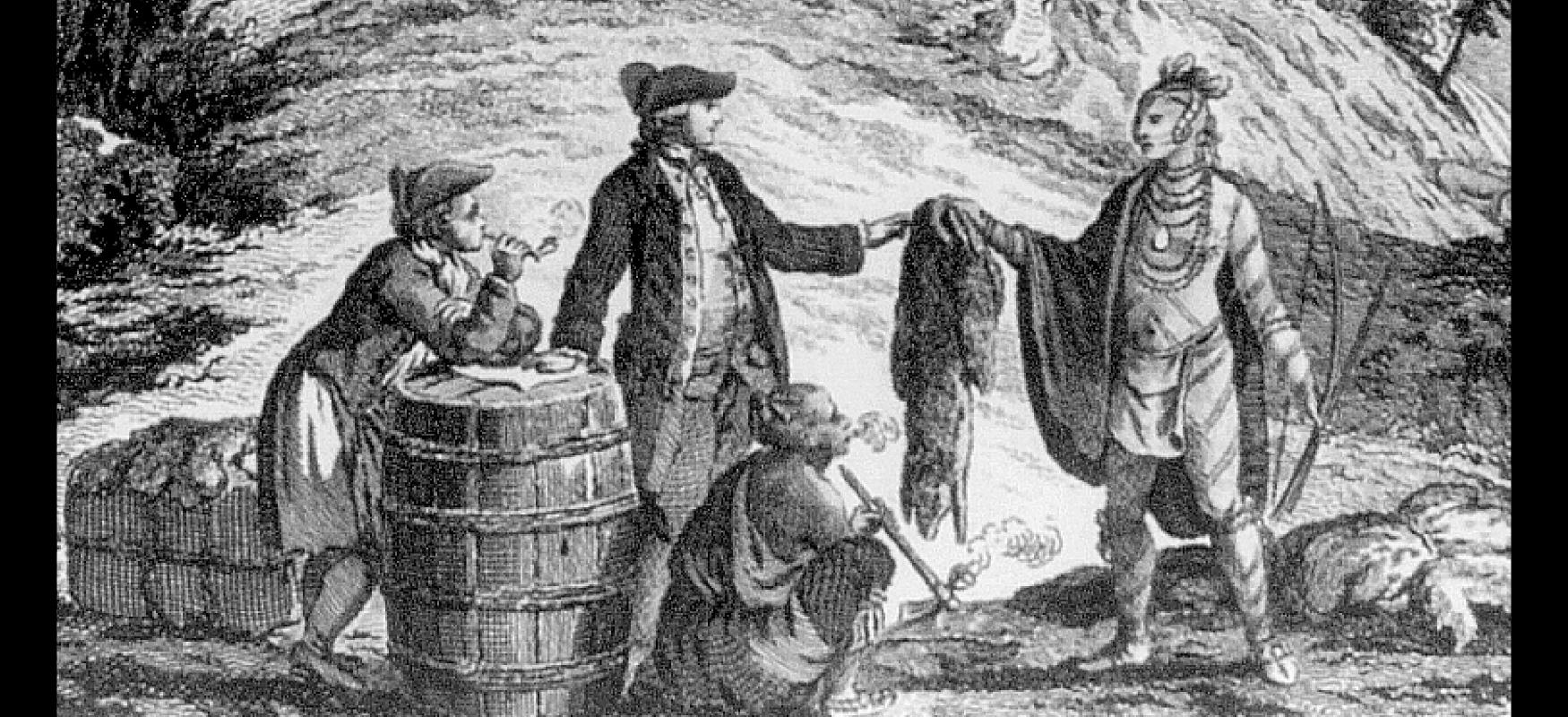
FIGURE 3.1 Furs and Tobacco. This 1777 Canadian image depicts European traders negotiating with Native Americans (called First Nations in Canada) in the course of the era’s highly profitable fur trade. Note that a European and a Native American are both smoking pipes, probably filled with tobacco, another important trade good at this time. (credit: modification of work “A Map of the Inhabited Part of Canada, Frontispiece by William Faden 1777” by Library of Congress Prints and Photographs division/Wikimedia Commons, Public Domain)
In the eighteenth and nineteenth centuries, the world’s great oceans effectively became highways as European colonizers, merchants, and laborers proved willing to journey greater distances than they had in the past and traveled to new destinations in the Americas, Africa, and Asia. New economic systems propelled exploration, communication, interaction, exchange, and—in many tragic cases—exploitation.
Communities in Asia, Africa, and the Americas that had once had little or no contact with one another now found themselves enmeshed in a variety of exchanges. Confronted with a changing world, every community made hard decisions. Some, like the Native Americans seen here (Figure 3.1), embraced the newcomers as trading partners or political allies, gaining access to new goods and sometimes profiting for a time. Others resisted the newcomers, often at great cost to themselves.
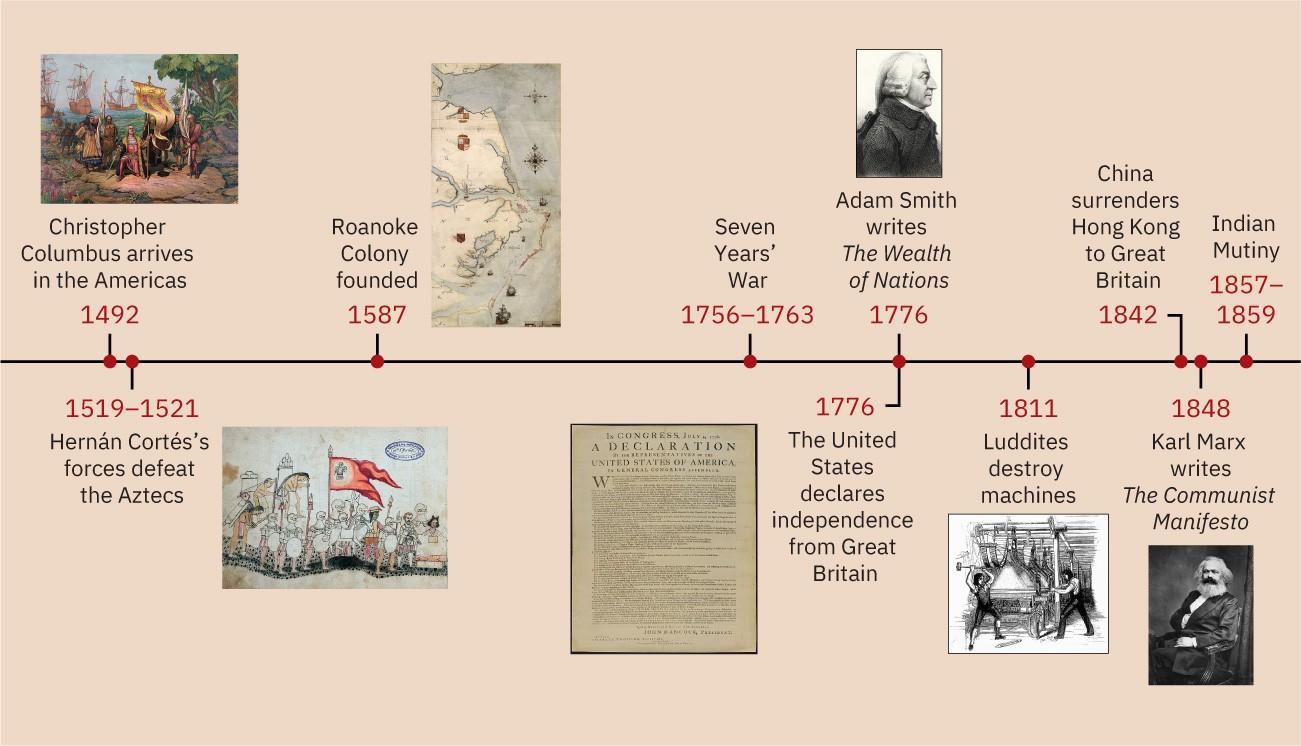
FIGURE 3.2 Timeline: Colonization and Economic Expansion. (credit “1492”: modification of work “Columbus taking possession of the new country” by Library of Congress’s Prints and Photographs division/Wikimedia Commons, Public Domain; credit “1519–1521”: modification of work “Codex Azcatitlan” by Gallica Digital Library/ Wikimedia Commons, Public Domain; credit “1587”: modification of work “Roanoke map 1584” by The British Museum/Wikimedia Commons, Public Domain; credit “1776 top”: modification of work “Profile of Adam Smith” by Adam Smith – Vanderblue Collection/Wikimedia Commons, Public Domain; credit “1776 bottom”: modification of work “Declaration of Independence” by Library of Congress/Wikimedia Commons, Public Domain; credit “1811”: modification of work “Frame-breakers, or Luddites, smashing a loom” by Unknown/Wikimedia Commons, Public Domain; credit “1848”: modification of work “Portrait of Karl Marx” by International Institute of Social History/ Wikimedia Commons, Public Domain)